Building date: 1844
Original use: Schoolhouse (Demolished 1893)
Corner structures:
Mortar application and content:
Types and uses of stones:
Types and choice of windows:
Structures with similar masonry details:
Masons who worked on building:
Unique features:
Map views courtesy Google Maps. Schoolhouse was demolished in 1893. The location was 4 Church Street next to the Cor-1 Unitarian Universalist Church.
Town of Cortlandville and Cortland County 1975 Highway Maps.
"Cobblestone School", Its History and Some of Its Well-known Teachers, Cortland Standard, Friday, October 25, 1895. Richard Palmer email 3/24/2021.
"The Old Cobblestone School", It's History and Some Teachers, From Essay Written 34 Years Ago, Cortland Standard, July 26, 1927
Having had several inquiries concerning the old Cobblestone school, and believing it to be of interest to many, the following is reprinted from the Standard of Oct. 25, 1895, being an essay written by John Tuthill, Jr., and read at the farewell exercises held on April 14, 1893, just before the school moved into the new Central building.
A day or two ago the Standard had occasion to look up the date, for the Industrial Edition, of the erection of the well-known old Cobblestone Schoolhouse that stood so long on Church street., and which was torn down in April, 1893 to make room for the handsome residence built that season by Mr. A.S.Burgess, who had purchased the lot.
Remembering that at the farewell exercises in the old schoolhouse held on April 14, 1893, just before the school moved into the new Central building, Mr, John Tuthill, Jr. of 23 Duane St., gave a history of the school accurately compiled from reliable statistics, we borrowed the essay to secure the date of its erection, which proved to be 1844. The essay as a whole is so excellent it gives so good an idea of the earlier education facilities of Cortland and record of the teachers in this particular school that we take the liberty of publishing it entire without even asking the writer's permission. It is as follows:
In 1844, Cortland was a village of about 1,000 inhabitants, and although smaller than Homer, which was her rival at that time, she claimed and held some note for her schools until the year 1840.
At this time Homer Academy, with its representatives from nearly every state in the Union, came to the front, and took the head among the academies of the middle states. Attendance became somewhat limited in 1849, due to a bill passed at that time for the endowment of public schools.
What might be considered as the pioneer school of Cortland was built near the site now occupied by the Messenger House. After this, no schools of any importance were erected until 1828. In April of that year the Cortland village seminary for young ladies was incorporated with Miss Jane Ingersol of Springfield, Mass., as preceptress, assisted by Mrs. Brewster, Miss McDonald and Miss Dutton. By paying the sum of $10 any one could become a member, and could vote for trustees. This event was soon followed by the founding of a school for young men.
The Cobblestone School next came into existence, in 1844, and was considered one of the best schools in Cortland, until out-rivaled by the Normal School. This lot upon which it stands was bought of Mr. Mead Merrill and Messrs. George Stile, J.J. Adams and James S. Leach, who were the trustees of District Number Nine.
The contract was given to Col. Johial Taylor, who let the mason work to Royal Gilbert for a sum not sufficiently great to pay his expenses. The benches were made of pine, and were arranged around the room with a narrow board for a seat. When reciting the pupils' backs were turned to the desk, but when ready to study, the pupil would rise, and step over the seat, which act was often attended by some little unpleasantness.
In the second part which is a wooden structure and which was erected some few years after the stone portion, the seats which would accommodate two at a desk, were placed in four rows. If those desks could now be brought to light, what stories they might tell through their carvings and rude decorations.
Could not some clever mind discover a new science, by comparing these carvings with the lives of the persons who had gone from school life into: "The world's broad field of battle, and out of life's hard school into that of the unknown."
Could not their characters be traced from these rude works of mischief and recreation? Would not these characters show that while the pupils were carving out the present, they were also with the help of another hand still more powerful, chiseling out their destiny in the unknown future?
In the index of a man's life and works, is not the influence exercised over him in school one of the greatest marks in his character and destiny? The truth of this assertion has been proved by those who have become great men, and still speak of lessons learned in school.
The Cobblestone schoolhouse appears to have first been built to accommodate the younger pupils in the district, who did not attend school at this academy. Before the building was finished school was being held in the basement of the Universalist church with Miss Annice Austin as teacher. And when the Cobblestone School was completed the pupils proudly marched in double file from the church to take possession. Then again, when the Normal School was incorporated and completed in 1869, the pupils, perhaps with envy, joined in celebrating the opening of their rival by parading with the other schools.
The old academy was now abandoned and those parts of its appliances and necessaries that were not well enough pressured to be used in the Normal School were sold to the other schools.
Mr. Isaac Seaman, then trustee, bought the old seats for the Cobblestone School. These, having framework of iron, were the first patent ones used. Three years ago when the higher grades from the ward schools were consolidated in this building, single desks were provided, whose style was quite in contrast with other fixtures not so modern.
If the walls could speak what tales they would tell; of the events of local importance, of the affairs of moment and nation, of the growth of the town - its evil and its good, of the doings of its teachers and scholars, of the battles fought by the. With self and temptation, and of how former pupils praise and revere the lessons early taught to them, within these walls.
The last event of any importance which the Cobblestone School has witnessed, and in which its pupils participated, occurred on October 21, 1892, on the occasion of the 400th anniversary of the discovery of America. The rooms in the school, due to the ingenuity of the feminine division were beautifully decorated with evergreen, flags and bunting. In this celebration the old age of the Cobblestone School was respected, and its representatives were given the lead in the lines of march. Among the many teachers who have distinguished themselves in connection with the institution may be found the names of Misses Ella, Mary and Abbey Palmer, Miss Cora Viele, wife of Dr. Goodyear; Mrs. M.A. Rice, Miss Elizabeth Hubbard and Miss Caroline Palmer, now Mrs. Fairchild of this place.
Mrs. Fairchild tells us that she taught for a number of terms in about the year 1854 and '55. Many pupils and no assistant; and that she taught nearly 48 weeks in the year including every other Saturday.
Other names familiar to many are those of Dr. James W. Hughes, the Misses Melvina Todd. Corinthia Kelsey, Eliza Austin, May Knapp and Florence E. Bennett, now the wife of Dr. H.A. Cordo.
Since the Central school has been in progress the property on which the Cobblestone School stands, has been sold to Mr. A.S. Burgess. This action will be regretted by many, as the building will probably be destroyed, and thus the only monument of the pioneer schools of Cortland will cease to exist.
But even though it will be demolished, its fame and existence will long remain in the memory of the teachers and pupils both of the past and present. This structure, when erected, was considered a fine one for those days - but as others of greater beauty sprang up about it, it became the object of jeers and sneers from the passerby:
Smile if it please you, at old fashioned ways.
The lessons we learned have served not to tell
We've a smile, and a tear for old-time days.
And the dear old schoolhouse, we loved so well.
When lessons and life are over at last,
May the roll call find us conscience clear,
And the Master, smile a loving 'Well done!'
As low at His feet we answer
"Here"!
Richard Palmer blog.
This structure is not listed in the Roudabush Survey.
Cor-1 First Universalist Church of Cortland Permanent File Info, Cobblestone Museum 8/11/1961. Editor's Note: The location of the schoolhouse is across the street from the church as noted on a map inset in this document.
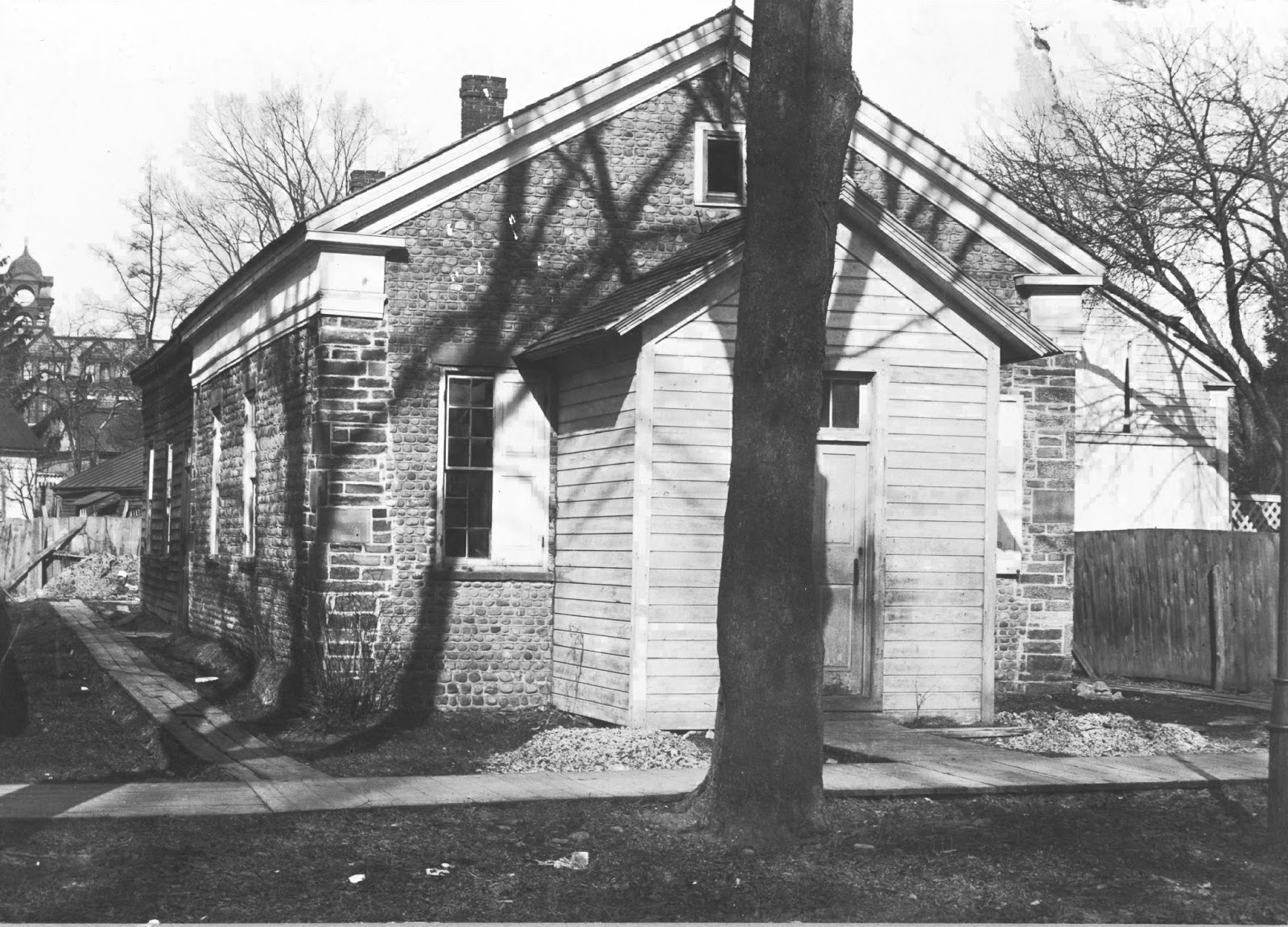 Image.jpg ¹ The District No. 9 two-room cobblestone school at 4 Church Street in Cortland was erected in 1844. It remained in use until 1893 and demolished shortly thereafter to make way for the new home of A.S. Burgess. |
¹ Image courtesy Richard Palmer, from Cortland County Historical Society collection.
